Fleet Hub
Building a new digital platform for Fiat Chrysler fleet and business decision-making

Fiat Chrysler Automobiles UK
Sector: Automotive, Fleet Mobility
Roles: UX/UI Designer, Developer, Project manager
2020 - 2023
Objective
Create a unified digital platform that consolidates fleet vehicle information across multiple automotive brands, enabling clear comparison, accurate decision-making, and scalable communication for business customers and internal teams.
Responsibilities
-
Product definition
-
information architecture
-
UX and UI design
-
platform development
-
stakeholder management
-
multi-brand integration
Brief
Fleet Hub was created to solve a long-standing structural problem in fleet sales: the absence of a single, reliable place where business customers could compare vehicles across brands.
Before the platform existed, fleet information was fragmented by brand, department and format. Model specifications, pricing and configuration data were distributed through trade shows, PDFs and printed materials, each maintained separately. Comparing vehicles across marques was slow, inconsistent and administratively complex.
When COVID-19 removed physical events from the equation, this fragmentation became impossible to work around. What had previously been tolerated as bureaucratic overhead became a direct barrier to business.
Fleet Hub reframed the challenge as a product opportunity: to consolidate fleet knowledge into one shared digital system, accessible to customers, dealers and internal teams alike.
Understanding the problem
Fleet customers needed to compare vehicles across multiple brands, yet information was fragmented across websites, posters, trade shows and sales conversations.
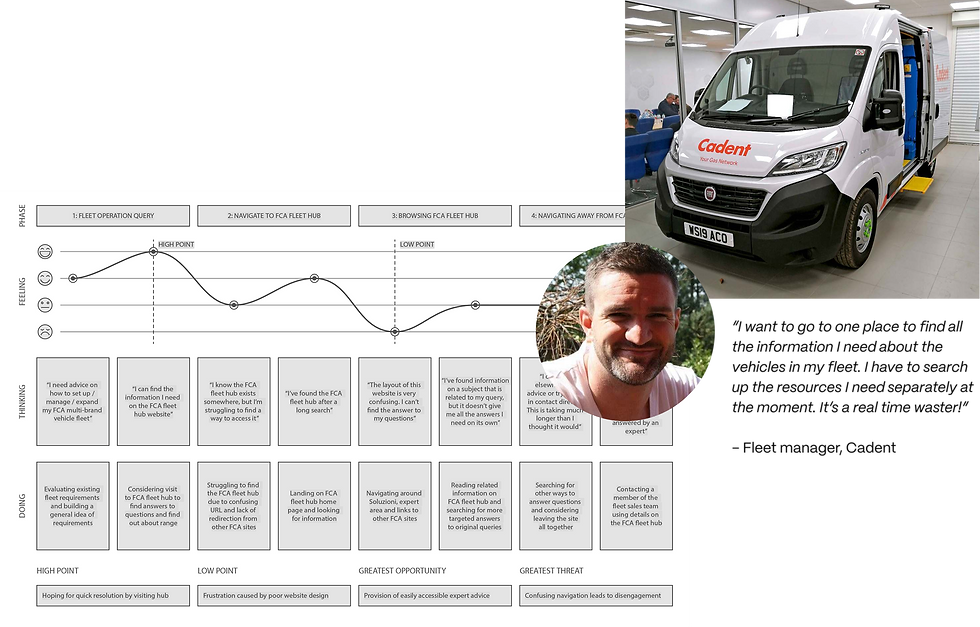
I conducted site visits and interviews with fleet managers and mapped their journeys across research, comparison and follow-up. This revealed repeated breakdowns: users struggled to navigate between brands, answers were scattered across channels, and contacting a sales expert became the default workaround.
The issue was not lack of information, but lack of structure and access.

Reframing and structuring
Rather than treating this as a navigation or content problem, I reframed it as a product and systems challenge.
I mapped technical, commercial and editorial data across brands to identify common structures and meaningful differences.
Inconsistencies were resolved, and a unified information model was created that allowed comparison without flattening brand identity.
This structural work shaped both the information architecture and the interaction model.
Designing and building
To move quickly, I developed wireframes in Figma, enabling rapid prototyping of layouts and components while laying the foundations for a reusable design system.
The system was designed to mirror how pages would be built in Webflow, reducing friction between design and implementation and enabling frequent updates in a fast-moving automotive context.
Testing was conducted with Stellantis business centre staff and with customers that had been contacted during the initial research stage.


Outcome and evolution
Fleet Hub became a central digital touchpoint for FCA fleet and business customers in the UK.
It enabled cross-brand comparison, simplified access to information, tools and resources, and supported fleet sales. Over time, its scope expanded to include editorial content, video and gated areas for existing customers, reflecting its role as long-term digital infrastructure for fleet and business support.
The platform continues to evolve in response to changes in the product range and market conditions.

What's next?
The Stellantis Fleet Hub still operates as the primary touchpoint for commercial customers in the UK.
The concept has received interest from other automakers as a white label solution.