
Brief
Farmland across the world is losing its ability to support crops. Heavy rainfall and intensive farming are compacting soil and stripping it of nutrients. When this happens, plants weaken and yields fall. There are fears that this problem will eventually cause a global food security crisis.
Farmers push harder to protect food output, but conventional fixes like chemical inputs and heavy machinery result in long-term damage to soil. They are forced to choose between keeping farmland productive today or protecting soil health for the future.
Regenerative agriculture offers a way to farm while restoring soil health, but this is a slow, risky and expensive process. Many farmers cannot afford the transition.
Aeropod is built for this reality. It offers a way to help rebuild soil health, without requiring farmers to sacrifice productivity.
Three guiding principles
Aeropod began as an exploration of how climate pressures expose the fragility of centralised resource systems, such as those for water, food and energy.
The aim was to create more resilient systems that operate autonomously, adapt to changing conditions and function effectively from small scale to global networks.

Self-sufficiency
Reducing dependence on external infrastructure by enabling communities to meet their own needs independently.
Self-regulation
Designing intelligent, responsive systems that automatically adapt to maintain balance and efficiency.
Scale
Creating flexible solutions that grow seamlessly from local use to global impact.
Learning directly from farmers


Field research with UK farmers revealed how climate volatility is causing big problems for agriculture.
Increasingly saturated soils, unpredictable weather and rising energy costs from irrigation and pumping are straining day-to-day operations.
Excess moisture, often more damaging than drought, shortens planting windows, causes compaction and reduces yields.


Prototyping early concepts
Several speculative concepts were explored, including visual soil sensors, wind-powered irrigation and topsoil aeration devices.
All aimed to reduce reliance on diesel, labour and centralised infrastructure to reduce waterlogging and compaction in soil.
Through iterative prototyping and validation, the focus shifted to a more fundamental question: rather than relying on an external solution, what if the soil itself could respond better to stress?
Gathering feedback to understand the core problem
Further visits to farms and conversations with farmers about our prototypes helped us understand the problems we needed to solve.
Feedback helped us understand problems in more detail, exposing how compacted soils trap water at the surface while remaining dry below, creating both waterlogging and drought stress within the same field
We soon revealed a consistent pattern: soil degradation is the root cause of declining productivity.


Soil as living infrastructure
A clear biological insight unlocked the innovation that would lead to Aeropod: rather than thinking of soil as simply a passive growth substrate, it must instead be seen as a living system which supports a complex ecosystem of microbes.
This ecosystem, or microbiome, is what maintains healthy soil structure and delivers nutrients to plants. If it is destroyed, plants can no longer grow in the soil without synthetic inputs.
The health of soil directly governs productivity. However 40% of arable soils around the world are already degraded, with that figure set to rise to 90% by 2050 unless changes are made.
What farmers need is a way of restoring soil health without sacrificing productivity.
So that’s exactly what we built.

A capsule that activates only when needed
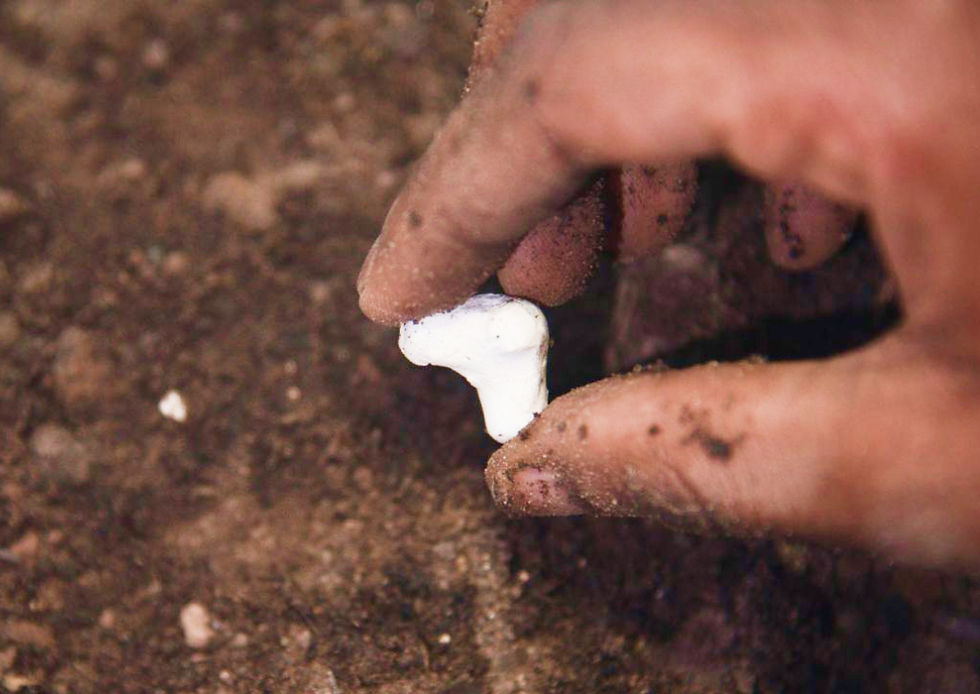
Aeropod is a nature-activated, biodegradable capsule planted like a seed beneath the soil surface. It lies dormant until it’s triggered by two factors: heavy rainfall and compaction pressure.
When water saturates pore spaces or machinery compresses the soil, the capsule activates, expanding through the soil to form temporary micro-channels that restore oxygen flow and drainage at the root zone.
As it expands, it releases a microbial biofertiliser to deliver nutrients that boost soil health. When conditions stabilise, the capsule biodegrades naturally.
Testing and development

_gif.gif)
Aeropod functions as a soil reflex. Early lab work focused on activation thresholds, shell strength and breakdown rates, which were then refined through field trials with partners including G and B Stops Farm and Imperial’s Silwood Park.
Farmers guided decisions on depth, responsiveness and the level of intervention that felt helpful rather than disruptive.
The result is a system that works without machinery, electricity, user input or chemical additives. It lowers reliance on diesel aeration and fertiliser while protecting soil microbiology.
Trials and modelling showed potential reductions of up to 60 percent in labour, machinery and fuel costs compared with conventional mechanical methods.

From prototype to platform
Feedback from farmers helped us refine the design of Aeropod, improving the shell design to make its aeration effect work in three dimensions. We also gained new ideas about how to expand its potential.
Strategically, Aeropod is positioned not just as a soil aerator, but as a platform for deploying agricultural inputs. Time-staggered capsules that can be adapted to protect seeds from weeds, deliver pH regulators, or dispense nutrients over the course of a growing season.
This creates a new logic for agricultural intervention: one that is embedded, responsive and non-destructive.
Starting up!


By late 2024, Aeropod had moved from proof-of-concept to active field trials, with farmers directly shaping its design.
The project subsequently joined, and eventually won, the Imperial WE Innovate accelerator, secured letters of intent for large-scale testing and began preparing pilots across the UK and Nigeria.
The team has generated close to £100k in grant funding by winning innovation accelerators and pitch competitions.


What's next?
Aeropod has joined the Imperial Greenhouse accelerator programme, with plans to run pilot tests on partnered farms in the UK and Nigeria.
I am excited to see Aeropod make regenerative farming more easily accessible to farmers across the world, particularly in poorer regions.
Supporters
Aeropod has been generously supported by several partners and advocates.


Recognition
Aeropod has won several international innovation accelerators and pitch competitions, garnering almost £100k in grant funding to support its development and expanding our reach with exhibitions in Austria, Dubai, Japan and beyond.