
Brief
Every year, over a billion tyres reach the end of their functional life. In the UK alone, about 600,000 tonnes of waste tyres are produced annually. Because vulcanised rubber resists decomposition and is difficult to process, only a small fraction is recycled. The rest accumulates in landfills and illegal dumps overseas, creating long-term environmental and safety risks.
How do you reuse a material that is engineered to be durable once it reaches the end of its useful life?
Investigating traditional British shoemaking

In the heart of England, Cheaney & Sons continues to make shoes the old-fashioned way. Skilled craftspeople are responsible for more than 200 processes which go towards making every single shoe.
The shoes are exquisite expressions of skill. They can last for decades with the proper care and maintenance, owing to the way they are made.


Inspired by manufacturing waste
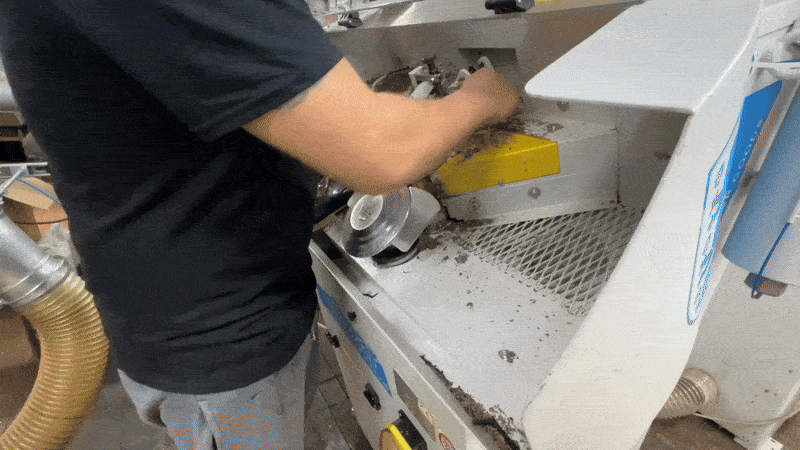
When shoes are made, and when they are resoled, the sole must be sanded flush with the upper. This produces a fine rubber dust.
I wanted to use this waste product to experiment with different ways of reusing vulcanised rubber at the end of life.
Making new shoes from material that is discarded during shoe production was my chosen framing for the investigation.
Attempting to reprocess waste rubber

Synthesising new bio-based polymers
Rather than using waste, a new material for shoe soles could be developed using more sustainable raw materials. The material should break down naturally over time without causing harm to its environment.

Re-plasticising waste rubber
During the vulcanisation process, sulphur cross-links form between the polymer chains in rubber to give it strength and elasticity.
Heat and pressure can be applied to some forms of vulcanised rubber to break the sulphur cross-links which bind it together, returning it to a thermoplastic.
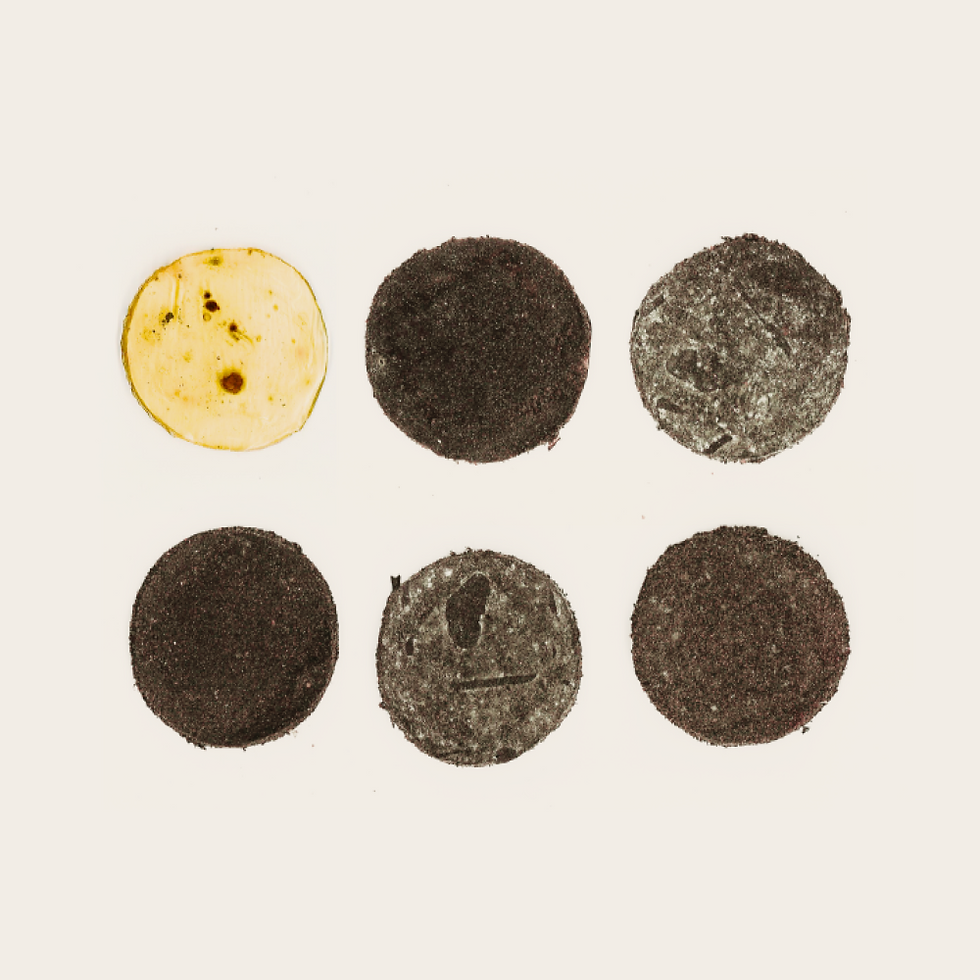
Reforming scrap with bio-based binders
A mixture of rubber and leather dust is produced when shoes are repaired, and leather offcuts are a common waste product in the shoemaking industry. These materials could be mixed with bio-based binders to create durable, flexible elastomers that could find use in new shoes.

A new high-value material from hard-to-recycle waste
I developed a rubber compound using waste from the shoemaking process, combined with a bio-based binder and preservatives. The result is a durable, flexible material with clear potential for reuse in new products.
Its stretch, resilience, and tactile quality make it particularly well suited for use as a shoe upper, turning problematic waste into a functional, desirable material.

Sketching footwear concepts
I began developing footwear concepts specifically to exploit the properties of the new rubber material.
The ambition was to use a poured moulding process to create a continuous sheet that could function as the upper, eliminating cutting waste entirely. This required rethinking how an upper could be formed, supported, and joined without relying on conventional pattern cutting.
The core challenge was translating a flat, zero-waste material process into a form that accommodates the complex geometry of the foot, while remaining durable, comfortable, and suitable for real-world wear.

Bikes as a teaching tool
The core of the project is a low-cost, CNC-cut plywood bicycle frame designed to be built by young people using salvaged parts.
It's inspired by my experiences building bikes when I was young from parts I would restore myself.
This is a subtle but important strategic shift. The frame is not positioned as a final product, but as a learning interface. It turns construction itself into the primary experience.
Thinking through making
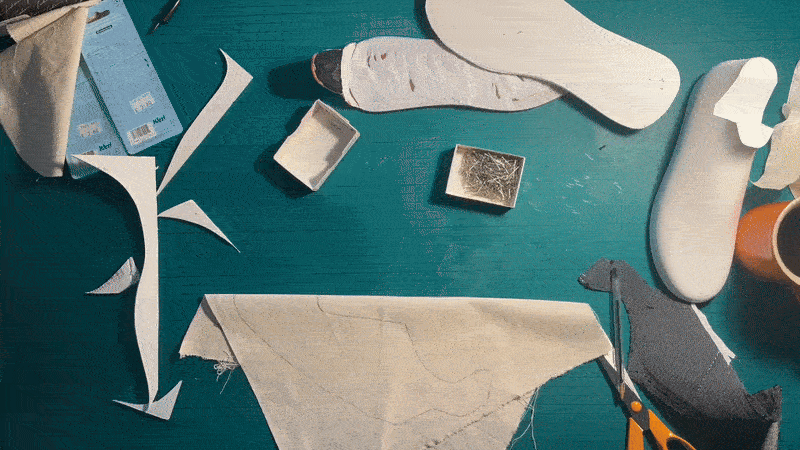
Using a traditional shoemaking technique, I made a pattern for a shoe upper over a 3D shoe last. I cut away at the pattern until I had a shape inspired by my concept sketching that I could recreate using my rubber compound material.
This gave me a design I could produce as a working prototype.

Prototyping
Upper development through physical prototyping, progressing from traditional patterns to a cast rubber upper formed directly from waste material.


Design details inspired by materials, modernity and tradition

Self-organising material structure
Recycled rubber particles are mixed into the TPU sole while it is still liquid. Vibration helps the particles settle at various levels depending on their size. Larger particles form a durable tread at the bottom of the sole, while smaller ones rise to the top, making the rubber more compliant for comfort.

Welted construction
Inspired by tradition, the shoe proudly uses a welted construction. The stitching around the outside holds the sole and upper together, and can be cut and re-sewn when the sole needs replacing.

Moulded upper
The material used to craft the shoe is cast in a mould instead of being stamped out of sheet material. Casting is an additive process which produces no waste, unlike stamping which produces offcuts as scrap.

Brut
Brut provides a case study for how ground tyre rubber can be used to make synthetic leather. Inspired by Jean Dubuffet’s Art Brut, it rejects polished aesthetics in favour of honesty in materials and making.
Traditional construction choices, including a Blake stitch welt and a one-piece upper, are left visible. These decisions allow the shoe to be resoled and repaired easily, extending its life without adding unnecessary material or process.